
Your Customer Conversations Are a Goldmine: How AI Turns Conversations Into Business Insights

Every day, your customers tell you what they want. They tell you what they like, what frustrates them, what they need help with, and sometimes even why they might stop doing business with you.
Most of these insights appear in ordinary conversations. A customer asks a question on WhatsApp. Someone contacts support through your website. A prospect asks about pricing. Another customer complains about a process.
Individually, these conversations may seem small. Together, they can tell you a lot about your business.
Your conversations are more than support requests
Traditionally, customer support follows a simple pattern:
Customer asks → Agent responds → Conversation ends.
But the conversation doesn't have to end there. If hundreds of customers are asking the same question, perhaps something about your product or process isn't clear.
If customers repeatedly complain about the same issue, there may be friction that needs to be fixed. And if customers keep asking for the same feature, they may already be telling you what they want next.
The information is there. The challenge is finding it when you have thousands of conversations to work through.
AI makes it possible to listen at scale
Manually reviewing every customer conversation isn't practical for most businesses. This is where AI can change the way businesses learn from their customers.
AI can analyse large volumes of conversations and identify patterns that would otherwise be difficult to spot.
It can help surface:
- Recurring questions and support issues
- Product feedback and feature requests
- Changes in customer sentiment
- Sources of customer frustration
- Conversations that need attention
- Potential sales opportunities
Instead of looking at thousands of individual messages, teams can start seeing the bigger picture.
Spot problems before they become bigger
One of the most useful things AI can do is identify changes in customer behavior. Imagine conversations about a particular issue suddenly start increasing, or customers begin expressing more negative sentiment about a product, service, or process.
These signals can help businesses investigate problems before they affect even more customers.
Sentiment analysis can provide another layer of context by helping teams understand how customers are feeling throughout their interactions.
A conversation that starts positively might become frustrated. Another difficult conversation might be successfully resolved.
Understanding these patterns can help businesses improve both the customer experience and the way their teams handle challenging interactions.
Let customer conversations influence your product
Your customers don't just tell you when something is wrong. They also tell you what they want.
They talk about missing features, confusing processes, products they wish you offered, and improvements they'd like to see. One customer making a feature request is useful feedback.
Hundreds of customers making the same request is a signal. By analyzing conversations at scale, businesses can turn everyday customer interactions into meaningful input for product, marketing, and business decisions.
Your support team may be sitting on insights that your product team would otherwise spend months trying to discover.
Turn insights into action
Understanding what customers are saying is valuable. Acting on those signals is where the real opportunity lies.
Conversation data can help businesses improve how customer interactions are managed.
For example, changes in message volume can help teams identify when additional support may be needed. Intelligent routing can help direct conversations to available agents and ensure customers aren't left waiting unnecessarily.
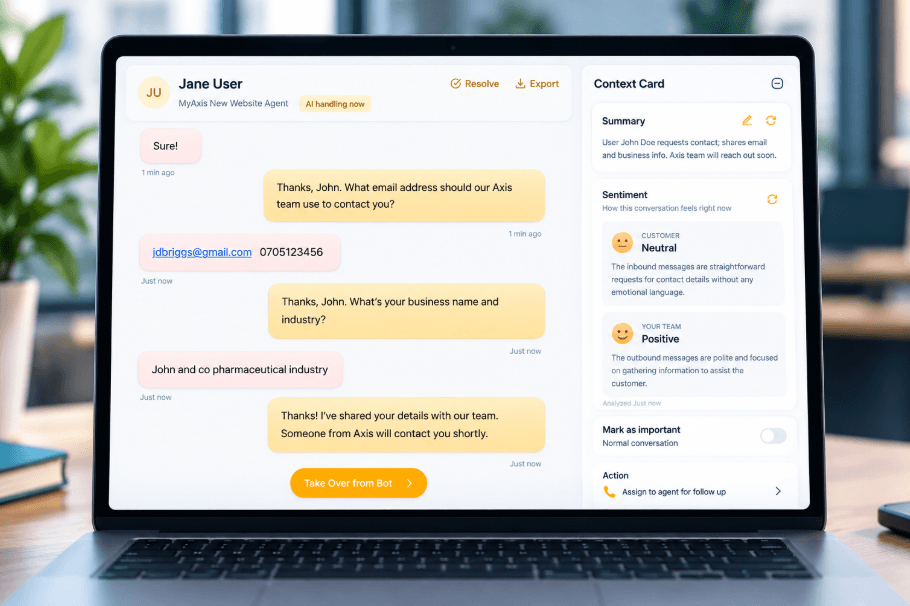
The same conversations can also uncover opportunities to grow revenue. A customer asking about pricing, availability, or a particular service may already be showing buying intent.
If they provide their contact details, that interaction can move naturally from a customer question to a potential sales opportunity:
- Customer question → AI engagement → Contact details → Lead → Sales follow-up
The conversation has gone from answering a question to creating a business opportunity.
Your inbox can become a source of business intelligence
This is where the value of AI-powered customer engagement goes beyond automation.
Axis Engage brings conversations, AI agents, sentiment analysis, intelligent routing, automation, and lead capture together in one customer engagement experience.
Instead of simply responding to customers, businesses can use those interactions to understand what customers are saying, identify emerging patterns, improve their processes, and uncover opportunities.
The deeper benefit is that customer conversations become part of how the business makes decisions.
Your customers are already giving you feedback. They're already telling you what's working, what's not, and what they want next. AI simply makes it possible to listen at a scale that humans can't manage alone.
Your conversations are already telling you what to do
Every customer conversation contains information. The question is whether your business is able to learn from it.
With AI, thousands of conversations can become more than a collection of support requests. They can become signals that help you spot problems, understand sentiment, improve products, support your team, and identify new opportunities.
Axis Engage helps businesses turn those signals into action, because your customer conversations aren't just messages waiting for replies.
They're business intelligence waiting to be discovered.
Keep reading

From “Hi” To “I’ll Take It”: How Conversational Commerce Is Changing The Way We Buy.
When Customer Support Becomes a Sales Opportunity

The Next Era of Customer Service: Human Expertise, Amplified by AI